Showing posts with label Martial Arts. Show all posts

Thursday, 8 January 2009

Some thoughts on war & peace

Last Sunday saw the first iaido class of 2009, an event marked with a wonderful party at a fellow student’s house afterwards. What I thought was going to be just a quick tin of beer and a chat turned out to be a whole afternoon of eating, chatting and watching videos of past iaido competitions and embu. Not to mention the obligatory beer, sake and shochu in good measure. I ended up sitting at the table with my new Argentine friend and fellow iaidoka, F, some new friends in the shape of a young American/Japanese couple and our teacher. As the drink flowed, the conversation turned to the more philosophical aspects of our practice.

Our teacher asked us in turn what had brought us to the study of iaido, as opposed to other arts, and what we hoped to gain from it. That’s not an easy question to answer, and everyone has their own reasons for pursuing this particular path of Budo. But for most people, I think it would be fair to say that they came to iaido not as their first discipline but as a supplement to their core art, be it karate, aikido or whatever. That was certainly the case for me, and also for F – we are both aikido men. Somewhere along the way, it seems that some (not all) people discover the hidden treasures that the study of iaido offers and the pursuit of knowledge of the Nihonto takes on a new, more profound meaning.

Perhaps other martial artists will understand the sense of “being in the moment”, of mushin (“no mind”) that comes with the dedicated study of any martial art. To try and explain it to someone who has not experienced it is like trying to explain the colour red to a blind person. Suffice it to say that there comes a time in most iaidoka’s study when they realise that the essence of the art is not in the physical act of drawing and cutting with the sword, but in freeing the mind from its self-imposed constraints and anxieties; from being able to move effortlessly from peaceful calm to lightning-quick activity and calm again with the mind undisturbed and unfettered. True proficiency in any martial art frees the mind from any thought of technique or pre-conceived tactics. The technique flows naturally and the mind floats serenely above, trapped by nothing and leaving nothing behind. It is therefore – paradoxically –through the study of conflict that one can achieve peace.

There is a saying in Japanese martial arts, Saya no uchi de katsu, which roughly translates as “victory resides in the scabbard of the sword”. One interpretation of this is that at the highest level, it is possible for a warrior to achieve victory through being so powerful that no one dares challenge them. In other words, peace through superior firepower. Such power in the hands of a just and right-thinking person is a powerful force for peace. The ultimate objective of martial arts is therefore peace achieved through a combination of mental and physical power moderated by a spirit of compassion and benevolence.

My teacher views the study of iaido in this way – as a route to peace rather than to war. My interpretation of this is simply that most conflict arises from fear. By removing this fear from our own hearts, through strict training and by pushing ourselves physically and mentally, we remove the need for unnecessary conflict, while at the same time developing an immovably resolute spirit that enables us to move decisively into action when action is required.

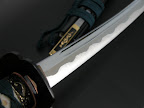
In the same way that the perfection of the Japanese sword blade is achieved by countless hours of labour, there is something about the process of continual and sincere practice in martial arts that seems to polish-out the imperfections of the human spirit and leave it revealed in its true beauty. That’s really what iaido means for me.

Sunday, 21 December 2008

Great expectations

I have just returned home from my first Bonenkai – the Japanese version of the Western Xmas party. Bonenkai means “forget the year”. While there is no tradition of Christmas here, as my last post explains in great detail, great store is placed in the year-end/New Year. So it’s a time to bring the year just gone to a close and to begin to look forward to the year ahead with renewed spirits of comradeship and shared endeavour.

Naturally, this is best accomplished with the aid of copious amounts of alcohol.

This evening’s do was courtesy of my iaido dojo. I say the word “my” with a good deal of pride, because I have today been formally accepted as a member of this dojo. This is actually a real honour and one that I am personally very thrilled about. I won’t bore you, dear reader, with the details but suffice to say, the lineage of my teacher – and therefore my own learning – can now be traced back over 450 years in a direct, unbroken line. It means a lot to me that I have been allowed to share in this treasured heritage.

But aside from all that, tonight was fun. I feel like I have joined a new little family. And I feel that I am a genuine part of it rather than just the “token gaijin”. I have read blogs by other western martial arts students in Japan – some of them in reference specifically to my dojo – where they have expressed a sense of bitterness about feeling “excluded”; of being allowed to participate, but not feeling part of the group. I am a bit perplexed by this, as this has not been my experience. It appears to me there can be only two explanations: Either I am too dumb to have noticed that I am being “excluded” or the person complaining of such exclusion has had a different experience to me. I genuinely feel it must be the latter, although I feel at a loss to explain why that should be the case. I suspect, however, that it’s something to do with people’s expectations.

Before joining this dojo, I had read on a particular blog about the “intense” sessions; the remorseless training regime that allowed no respite. As a middle-aged bloater, the words “intense” and “training” used in a single sentence are a genuine cause for anxiety. But as someone who prefers to make up his own mind, I went anyway.

The first class was tough: My legs hurt like crazy for a week afterwards and I had no skin left on the toes of both feet. But this is not unusual – I’ve had the same experience in England many, many times. It’s called a normal training session. It’s what I would expect from following any martial art discipline. Nobody said much to me while I was there – it didn’t bother me because I was there to train. So I went again, and again, and again. Slowly, people respond to the fact that you are serious about what you are doing.

The act of willingly putting yourself through a physically difficult routine is really the essence of martial arts. What you are doing is conditioning your mind as much as your body. But of course, if it was easy, everyone would be doing it.

Unfortunately, this seems to have become the case with iaido in some parts of the world – the UK included. In some quarters, the perception of iaido appears to be – as with some Aikido schools – that it is a purely esoteric/spiritual pursuit, completely abstract to a real physical confrontation or a life-or-death encounter with an opponent armed with a razor-sharp sword. Consequently, the attitude in some quarters appears to be that if you don’t feel comfortable with a technique because your knee hurts or you are too fat to sit in tate hiza or you don’t like doing breakfalls, you can adapt the technique to suit your liking. Of course, this is utter nonsense.

In the UK, for example, it is very common to see people performing kneeling techniques from a standing position, even during a grading or in competition. I have not seen that done once here: either you do the technique properly, or you don’t do it at all.

There is a reason for that: It is the act of deliberately throwing yourself at the ground, or relentlessly practicing the same sword technique, even though your toes are bleeding and your legs are killing you that is training your mind to cope with difficult physical situations. The discomfort is the very essence of martial arts practice. Some people just can’t deal with that. Perhaps it is a sad reflection of our something-for-nothing western culture that some of these kind of people appear attracted to iaido because they see it as an easy route to a dan grade in a martial art. That maybe true in some places. But not here.

Personally, I am very happy to have been given the opportunity to spend 3 hour sessions under the gaze of an attentive and extremely knowledgeable teacher. I don’t expect anything in return – fancy certificates or impressive titles -  nothing except the hope that my technique will improve if I work hard and that I will enjoy the companionship of my fellow students while I practice. And perhaps even a few beers afterwards…What more could any martial artist want?

Monday, 3 November 2008

The journey begins

I have now started training at my friend K-san’s dojo in central Tokyo. And what a marvellous experience it is. In the space of just one week I’ve managed to pack in no less than 9 hours solid training – that’s an incredible improvement over what I’m able to do in the UK. I don’t mind admitting a little nervousness at joining the dojo – I’d read some reports that the regime was a little harsh for Western tastes, but I was pleasantly surprised at how relaxed it actually was. I’m not sure what kind of training the guy who’s review I’d read was used to, but despite the fact that I’d not trained seriously for some months, I didn’t think it was too dissimilar to the sessions we are used to in the UK. Although after the first one, my legs were pretty painful and I’m still waiting for the skin to grow back on my feet. Still – it’s my own fault for being lazy, so no sympathy!

The standard of Iaido here is quire simply in a different class to the UK. I have a good friend who lived and studied here for a long time, and he always bemoans the standards in the UK. Now I can see very clearly what he means. I have been extremely fortunate to have had some personal instruction from my new 7th dan teacher, and the effect has been nothing short of dramatic. My cuts have suddenly taken on an expansive, powerful quality that is quite extraordinary. I feel quite sure my skill will increase in leaps and bounds with continued practice.

The class itself is held in an old school gym – very similar to the gym at Simon Langton's in Canterbury where I trained with K san and P last Summer. The only difference is the smell of the yakitori wafting in from a nearby restaurant – makes it pretty hard to concentrate when the old stomach starts rumbling!

Sunday, 26 October 2008

All Japan Iaido Championships

Yesterday I travelled up to Sendai with my friend and Iaido colleague K san for the All Japan Iaido Championships. This is an annual event that changes venue each year. This year’s host city, Sendai, lies about 300 miles north of Tokyo, necessitating a rather early start and a long drive – made all the more difficult, incidentally, by our ill-judged decision to dally overlong at Yebisu’s in Nishi Ogikubo last night. But I digress.

EIDO-1660 We arrived in Sendai City after a drive through some pretty spectacular scenery. The Kanda plain on which Tokyo sits is surrounded by mountains that rise suddenly and unexpectedly from the billiard-table flat countryside. It is an impressive landscape – perhaps due to its volcanic origins – quite unlike anything that I’ve seen in Europe; Steep mountains and deep valleys, all carpeted by dense forests. As we travelled north, the leaves became increasing tinged with gold and red – a tantalising preview of the spectacular display to be played out over the next few weeks.

EIDO-1662 The city’s sports hall is quite an impressive facility, and by the time we arrived, the competition was in full-swing. Unlike the Nationals in the UK, this competition appeared to be restricted to just 5th, 6th and 7th dan competitors. Consequently, the standard was – as you’d expect – pretty high. But what really surprised me was the number of very high grades there. In the UK, the highest grade we have is 7th dan and there is only a handful of them. Here, there are lots more, not to mention a surprisingly large number of 8th dans. I thought 8th dan was the highest possible, but apparently there are three 9th dans still alive and one of them gave a demonstration yesterday. Quite amazing – he must have been well into his 80s. There’s hope for me yet.

I met with my new sensei and was introduced to some of the other students and given the official OK to commence training, although it will be sometime before I am given any form of direct tuition. I have to prove I am serous first – just goes to show the limited value of my 2nd dan grade!

Along with the impressive Iaido,there were some pretty impressive toys on display yesterday. Each one of these swords isEIDO-1683A a shinken – a real, razor sharp sword forged in the traditional way by a certified swordsmith. And as you’d expect, each has a price tag to match. This selection started at about 65 man Yen – about £3,200.

By for me – the highpoint of the day was the mass demonstration by 7th and 8th dans. There were far too many great Iaido practitioners to take in in one go, but I did spot some fantastic techniques. Oshita sensei – perhaps the most EIDO-1717 important teacher for UK Iaido – was just below where we were sitting in the balcony, impressive as always. But just one of many, many other great displays.

Saturday, 4 October 2008

Following the trail

Last night I made contact with my iaido friend and mentor here in Japan. We had a very pleasant evening discussing the state of iaido, both here and in the UK and catching up on all the latest news. He mentioned that he had already talked to his teacher about me joining the dojo, and the teacher has said I would be very welcome. I am thrilled by this. It has been an ambition of mine to train in Japan for nearly as long as I’ve been involved with martial arts, which is quite a long time now. Hopefully this dream will come true soon, although I’m sure I will have plenty of moments when I wished it hadn’t – the training here is considerably harder than in the UK. But you know what they say, no pain – no gain.

On the train home, I got to thinking about the traditions of my school, and the value that such a long heritage imparts to the style. In particular, how fortunate I have been to have struck lucky in the lottery of martial arts instruction; my path leading from humble beginnings in Sidcup all the way to Tokyo and who knows where else.

Embarking upon a course of instruction in any martial art is like arriving by boat in a wide river delta. From the perspective of the visitor, all the little streams and channels look pretty much alike. It’s only once you have ventured down them that you discover whether they are quiet backwaters, silted-up tributaries or whether they broaden and deepen, joining with other streams, allowing you to navigate further into the fertile hinterlands of knowledge and wisdom that lie beyond.

I have indeed been fortunate to have chosen just such a path. I just hope my frail little ship has the stamina and constitution to survive the rigours of the journey that awaits.

Monday, 25 August 2008

A lesson learned

Another day of toil; a bigger pile of rubbish and more problems. It’s looking increasingly likely I’m going to have to just give away some expensive items like the tumble drier and Little M’s bed because I can’t find any takers. My mum said to just do it and forget about it; “You’ve done your best so you can’t do any more.” She is right.

Although she doesn’t know it, she’s reminded me of one of my most important philosophies – that of letting go of things that don’t matter anymore. In Wing Chun, the striking fist contains energy only at the moment of impact: Too soon, and strength is wasted and the blow becomes slow and cumbersome; too late and the energy contained in the striking limb can easily be turned against you and your whole body unbalanced. Life is a bit like that sometimes. Everything has it’s right time for action; a right time for energy to be focused into it. Like the striking limb that’s too tense, putting energy into things at the wrong time can actually work against a successful conclusion. Holding on to something – expending emotional energy on something - that is no longer of use is just as damaging. I think there is a passage in the Hagakure of Yamamoto Tsunetomo that says something like “Waste no time on useless things.” This is sound advice.

A central tenet of Zen Buddhist philosophy is that all human suffering derives from our attachment to things that are impermanent. Possessions, money – even life itself – are impermanent constructs and will one day slip through our fingers like water. Perhaps a lesson from today is that rather than expending energy on trying to hold onto things that can’t be held, I should be celebrating and be thankful for the good things that they represented when they were part of our lives here in Canterbury.

Wednesday, 25 June 2008

Hmm…

Jeff’s blog Tales of a Budo Bum has a post about a new martial arts book 

There’s been a bit of discussion about this book and its author on the various kendo forums. I can’t really comment on either – not having read the book or being conversant with its author. However based on what I’ve learned through other commentators, there are a few points that I think are worth making: Firstly, it’s clear this guy is no classically trained swordsman. He has no interest in history, culture or koryu, only the effectiveness of the nihonto in cutting people down. In true NRA style, this morbid fascination appears to be justified by the well-worn “self-defence” argument. This is a hair’s breadth away from the mentality of the gutter thug and completely counter to the path of the martial artist.

Secondly, books such as these play straight into the hands of paranoid legislators who would like nothing more than to ban all forms of martial arts. In the UK, “samurai swords” are now banned. Martial artists are – for the moment – exempt but there are already rumours of a total blanket ban on the horizon. If and when it does happen, it will be books such as this that will be held aloft as justification.

Lastly, in the light of the recent tragic events in Akihabara, the Japanese government is now looking seriously at introducing legislation restricting the sale of edged weapons. Once again, it’s not hard to see how Mr. Elmore and his encouragement to use the nihonto to lethal effect could justify the argument that all sword art practitioners should be viewed as paranoid survivalists with an unhealthy interest in weaponry.

The study of the sword is not about killing; it is about becoming a better person, achieved through diligent and sincere training in a recognised school. Neither Jeff or anyone else on the Kendo forums seems willing to condemn this book, which I find quite surprising. I however have no such reserve and I feel it should be condemned: Encouraging people to own and use the nihonto purely for violent purposes – howsoever justified – is wrong. 
 

Tales of a Budo Bum

Monday, 28 April 2008

The uncertain teacher

The last few weeks have been very enjoyable from an iaido point of view. Twice a week I am trekking up the hill to the University to join in with their early morning sessions. This has given me the chance to experience teaching for the first time, and I am eternally grateful for the opportunity. I feel a little awkward because I do not feel in the slightest bit qualified to be telling anyone else how to do iaido, yet it is gratifying to be able to convey my modest knowledge of the basics to beginners. Even though I'm sure my technique looks appalling, my hope is that at least I might put them on the right path.

From my perspective, having to explain techniques is forcing me to examine my own understanding in greater detail, and this in turn has proven extremely beneficial in exposing weaknesses to be corrected.

In my own training, I have to be extremely careful not to become complacent. I read the memorable phrase "fur lined rut" somewhere, used to describe this phenomenon. I have been concentrating on omori ryu a lot recently. Sometimes it's looking ok, but other times I feel totally inadequate - particularly on ushiro. I just can't get the timing or balance right to make the technique work convincingly. Ah well がんばる!

Saturday, 5 April 2008

Sensei Beerhound - gulp that's a scary thought

Yesterday was an important milestone in my martial arts career. For the first time, I was invited to teach a class. It was a scary, but immensely gratifying experience. I don't consider myself to be particularly knowledgable or skillful, so I was flattered that the dojo leader thought I was worthy of sharing what little knowledge I have. Hopefully I didn't display my ignorance or steer those students too much in a wrong direction. I have the opportunity next week to join two more classes, so I look forward to leading another couple of sessions.

The satisfaction I feel is not really related to my personal ego, but rather to the honour and joy that comes from sharing the skills and traditions of my school. It's so much a part of my life now I think think of Eishin ryu iaido not as something that I do, but as something that I am. If I can convey a little of that feeling - even through my clumsy unrefined technique - I'd be happy.

Sunday, 9 March 2008

Grading success

This weekend was the BKA Spring Seminar and Grading at Watchet, near Minehead. Myself and two of the guys from Shinmyo Ken went in for our Nidan (2nd Dan Black Belt) grading this weekend and thankfully we all passed. I am really pleased, but still a little shellshocked and knackered after the weekend so it hasn't really sunk in yet. Gaining Nidan means that we now have a minimum 2 year wait until we can consider grading again. This period gives us a chance to put the standard seitei kata study (modern style) on hold and really devote some serious time to koryu (traditional style). So this really marks a watershed in my iaido career and the chance to get more into the essence of the art. Interesting times ahead, I feel.

Thursday, 17 January 2008

Back to school

It's been a while since I posted on the subject of martial arts. But my fast-approaching nidan exam has bought my iaido back into focus. It's actually been quite useful to have had a little break over the last couple of months. Coming back to it now, I feel my technique has benefited from the rest, principally by becoming more relaxed and open. Seems strange, but I have had somewhat similar experiences many times in my musical career, so it seems to be something inherent in the learning process. Perhaps we need to step back from our studies from time to time, just to take stock, assimilate what we've learned and make it our own.

Getting back into the training is an enjoyable experience. The pleasure that comes from a well executed technique is really hard to explain, but satisfying none the less. But more so perhaps is the journey - the challenges, the frustrations, the first flickers of hope and finally the first "good one". The more I practive, the more I discover that it's really the journey that's important.

Sunday, 6 January 2008

Does the stiff upper lip still exist?

The subject of starting life in Japan continues to occupy my thoughts a lot of late. It is an exciting prospect, but also a little daunting. The idea of living in Japan has always been on my agenda, even before we got married, so I have quite naturally done a lot of research on the subject. During that research, I've naturally uncovered a lot of plusses and a lot of minuses. But interestingly, most the stories and comments you find on the 'Net are from Americans. Not surprising I guess - I'm sure there are a lot more Americans in Japan than English. Yet I've often wondered why it is so rare to find a negative comment from an English person about living in Japan. This led me to wonder whether there might be a reason for that - other than sheer laziness, of course.

While in Japan recently, I had a good conversation on the subject of iaido with my friend and sempai Kuni Sumida - a very talented iaidoka. We were talking about the meaning of iaido in a modern context; what motivates individuals to embark upon that path and what keeps them driving forward on their long and sometimes frustrating pursuit of perfection. Kuni-san pointed out the deeps links between iaido and classical Bushido - the traditional "Way of the Warrior". In modern Japan, of course, there are no more feudal lords or battles to be fought. But perhaps in many ways, the place of the Daimyo has been taken by "The Company". Modern-day "Bushi" are expected to give total commitment to the Company, much like their Samurai forebears. It is as a means of developing this mind-set of loyalty and commitment that iaido practice still has immense value in the modern age. And not just iaido - calligraphy and tea ceremony are other examples of traditional Japanese arts where proficiency can only be achieved through patient and dilligent practice over a number of years.

I was reminded very much of my own experience as an apprentice engineer - way back in the mists of time when you still saw labels that said "Made in England" and it meant something. I will never forget the first day: Clad in poorly fitting overalls, 80 of us stood nervously by our benches wondering what we'd let ourselves in for. I remember my gaze alighting upon a sign that had been hung on the wall of the cavernous workshop where we stood: I mused upon the meaning of the words "Smile as you file". We found out shortly afterwards: Each one of us was issued with a file and rusty lump of steel plate, with instructions that we should make both sides of that plate flat and parallel. When they said flat, they meant within thousanths of an inch. So began several weeks of filing - at first clumsy, but slowly more accurate and skilful. With this growing skill came a growing pride in this new-found ability that our patient efforts had uncovered within ourselves. Nobody who did that course ever forgot that lesson, and no matter what path each of us took in life after that, the pursuit of excellence became a matter of personal pride.

This combination of skill and pride, instilled at an early age, was so important to the success of British industry. Likewise, I would argue, to Japanese industry. Without it, nothing could ever move forward or improve. But this skill can only be forged in many hours of hard effort. And here is where modern UK and Japan differ: Japan still has people with this kind of personal grit - the UK, it seems, rarely so. My personal feeling is that this softening of our resolve is a natural consequence of today's something-for-nothing, buy-one-get-one-free culture where people seem to expect great things to fall out of the sky into their laps with minimal effort of their part. I would argue that this is perhaps something we have picked up from too long gazing across the Atlantic to the home of consumerism, the US.

That's not to say that the US to blame for UK's modern malaise - simply that as Western societies, we have chosen to go down this route. The US is just a little further down the road, that's all. So maybe the real reason behind the lack of comment from the English about Japanese life is really more to do with changing attitudes of the younger generations. Perhaps the backward English of my generation are still clinging to the last vestiges of the "stiff upper lip", making them far more likely to just get on with the challenges of living in Japan. Maybe we are just not used to the same standard of living as our American cousins, and so find less to complain about. But on a personal level, whatever it is, I'm really hoping that my personal life experiences will have prepared me well. I don't want to let the side down. That would never do.

Tuesday, 24 July 2007

An inspiring experience

The visit of Hatakenaka sensei was universally considered a success, and I think all the attendees would agree with me when I say it has been a truly inspiring 4-days of iaido and budo. Hatakenaka sensei is very good indeed, superb in fact. I hear she will be challenging 8th Dan next year, which is the highest qualification possible in iaido under ZNKR rules.

But perhaps the most inspiring thing has been the enthusiasm and openmindedness of the organising club at the University. They have embraced these new ideas about their iai with real passion and committment. Their earnest and diligent approach to learning a completely new syllabus has been truly impressive. The efforts made by the guys at the Uni, Doug Evans and the attendees from Minato Ku have been tremendous and have had an extremely positive effect on my iaido, and of everyone that was there.

By contrast, the usual BKA "clique" was notable for its absence. There are several high ranking dan grades within an easy drive of the University that clearly could not be bothered. I wonder who have shown themselves to be the true students of budo - those with titles and high ranking dan grades, or those that have approached the teaching with humility and enthusiasm. I know what I think!

Monday, 16 July 2007

The life giving sword

This weekend sees the visit of Hatakenaka sensei to Canterbury for a 4 day iaido seminar. This is a most significant event and one, which although I am looking forward to, I am also a little nervous about. From what I have read, Hatakenaka sensei is a hard taskmaster. I just hope my poor knackered body can stand the pace. The driving force behind this seminar has been a guy at the University who runs a karate club that includes iai-jutsu as part of its syllabus. The school that they follow is not a classical style, but one derived in the 1930s to teach Imperial Army officers how to use their Army-issue weapons. I don't know this guy, but I have seen the kata that they practice because they have posted videos on the internet. It does indeed seem a very "practical" style. This has prompted me to think about the differences between a "do" and a "jutsu" style and the implications that each have on the "why" we practice, as opposed to "what" we practice.

Most martial artists understand the difference between "do" and "jutsu" to be the difference between using martial arts as a means of self-development as opposed to learning how to win real fights. I read something recently that says this differentiation is actually a modern Western invention and has no meaning in Japan. However I am pretty sure that is incorrect.

Modern Japanese people in general have an abhorance of physical violence, and to resort to violence to settle disputes is to considered to be extremely course behaviour. This attitude comes in large part from the period immediately after the last war, in which the Japanese population paid an extremely high price for their nation's aggressive behaviour. Before the war, Japanese martial arts had become closely associated with nationalistic philosophy and for this reason, martial arts were all banned by the occupying American forces after the war. Even though the ban was lifted in 1953, This association between nationalism and martial arts still exists in the minds of many Japanese people. To see Westerners flailing around with swords makes many of them uncomfortable still.

Yet despite this, it is clearly recognised that the discipline and personal growth that the pursuit of martial training can achieve brings many positive benefits. So it was that the "do" philosophy, with its emphasis on personal development as opposed to combat effectiveness, has become the prevalent one in Japan today and the rest of the world. There are however a significant number of people - mostly in the West - that regard combat effectiveness as an important goal for them. Hence the rise in MMA and the endless discussions in martial arts magazines about "would it work on the street". I think when you are talking about unarmed styles, I think this can still be a valid point of view. We live in a violent society, and many people feel the need to equip themselves with effective fighting knowledge - this "jutsu" knowledge. However, as we don't (yet) live in a society where life and death encounters with a sword are common, I struggle to see the relevance of "jutsu" when it comes to the sword arts.

Iai-jutsu (Toyama ryu to give its technical name) arose as a practical response to a practical need, that of training Army officers to use their weapon to kill effectively. This is a very different objective to training in a classical style to improve awareness, concentration and co-ordination. Personally, I find it rather disturbing that anyone would want to follow this path. You don't, for example, see "Canterbury Bayonentting Club" listed anywhere, yet iai-jutsu amounts to the same thing. And, because it was designed to teach inexperienced students the basics quickly, it lacks the depth of a classical style.

I don't like to be critical of someone else's school, but I have to be honest and say that I feel extremely uncomfortable with the idea of "iai-jutsu" as I have seen it demonstrated. There is, for example, one technique in the syllabus that looks like it was intended to behead a kneeling prisoner. This is about as far away from the practice and philosophy of classical Japanese martial arts as you can get. I can only hope that this weekend will prove a revelation for these "iai-jutsu" guys to think again about what they are doing.

Sunday, 1 April 2007

slow-faster-fastest-stop!

The following is an extract from a book called Lost Japan, by Alex Kerr. I discovered it on an excellent blog site put together by a Canadian guy called Jeff.

The folding of the fukusa, the sliding movement of the feet in Noh, the grip of the sword in martial arts - everything was difficult. Moreover, as the seminar progressed, it became clear that these movements were not merely ornamental, but expressed a philosophy. For instance, I encountered the rhythm jo, ha, kyu, zanshin; basically this is quite simple, amounting to "slow, fast, faster, stop". When wiping the tea scoop with the fukusa in the tearoom, we were taught to start slowly (jo) speed up a bit at the center of the scoop (ha) and finish off at the end quickly (kyu). At the instant one draws the fukusa off the tip of the scoop, there is the closing zanshin, which means "leaving behind the heart". Then one returns to zero, in preparation for the next rhythn of jo, ha, kyu.At first I thought this rhythm was a pecularity of tea, but I soon found that it applies in exactly the same way to the foot movements and raising of the fan in Noh drama. In martial arts and calligraphy as well, this rhythm governs all movements. Over the course of the seminar I realized that jo, ha, kyu underlies every single one of Japan's traditional arts. The teachers went on to explain that jo, ha, kyu, zanshin is the fundamental rhythm of nature - it defines the destinies of men, the course of eras, even the growth of galaxies and the very ebb and flow of the universe.-Alex Kerr

Sunday, 25 March 2007

Free the mind and your ass will follow!

Writing in his work Hei-Ho-Kaden-Sho (Hereditary Manual of Martial Arts), Yagyu Munenori (1571-1647) said ,"A mind that stops changing and becomes rigid will result in disaster. While mind, with no shape and no colour, is imperceptable to the eyes, it is still recognisable if it is fixed and strays over something. Just as white silk becomes red in colour if it is stained with red dyes, so the human mind becomes visible if it is stained by emotion or thought." Achieving the state of mushin ("no mind") is the goal of martial arts training. A mind that is visible because it is coloured by thought or emotion, cannot by definition be in a state of mushin. No embu in Iaido should therefore show the emotions or thought because this would betray a mind that is fixed and rigid. This illustrates the link between Zen philosophy and martial arts very well. A mind that is visible to an enemy means that he can easily devise a strategy to gain victory. A mind that is free and can move without restriction cannot be caught in this way.

Thursday, 22 March 2007

Making the grade

My recent grading to 1st Dan Iaido is a source of great satisfaction to me. But with it has come some mixed feelings. Or possibly, the act of achieving a personal goal has simply revealed that there are many more peaks to climb on this journey

I discovered, by chance, an excellent blog by a young guy called Richard who also graded to 1st Dan on the same day that I did. One of the things that he mentioned was that he'd spotted a couple of people grading to 1st and 2nd Dan that he felt didn't quite hit the mark in terms of the standard of their Iaido. Hopefully he wasn't referring to me! His comment was that by being awarded the grade, his own - our own - grading had been devalued as a result. My gut reaction was to kind-of agree with that: I have heard of people that have graded to ikkyu after just one or two months of practice. In our dojo, we have to pass kyu gradings all the way up from 6 to 1 before we are allowed to go forward to do the national grading. In my case, around 3 years of patient study. And this is pretty fast by Japanese stadards! I have seen some pretty appalling Iaido (thankfully not too many examples at Watchet)which has neverhteless resulted in a grading pass. There is no doubt in my mind, that there is a definite BKA "clique" which favours certain individuals over others. However, on reflection, I have realised that to trouble ones mind with such thoughts is actually to miss the point of Iaido

The point of Iaido - in my humble opinion - is simply to enjoy the journey, not the thought of the destination. We don't wear distinguishing marks like coloured belts because such outward manifestations of grade are actually quite meaningless. It is the inner journey that marks out the committed traveller from the casual one. It's no accident that Koryu has no gradings. We all like to feel we've achieved some form of recognition for our efforts. But personally speaking, the satisfaction that comes from understanding and performing a technique well is infinitely more rewarding.

Sunday, 18 March 2007

The art of expression

In Iaido, we are constantly challenged with trying to achieve the 'correct' way to demonstrate technique. This search for perfection is an indisputably important aspect of practice, for it is through this constant effort that we train and hone the spirit to become better individuals. But, worthy though it is, the quest for perfection is a virtue that can be taken too far. Taken to excess, slavish adherence to 'perfection' can, I believe, damage the true spirit of Iaido.

Iaido is a martial art. An “art” – as opposed to a science – encompasses a broad range of truths. Unlike the cold logic of a science, an art is a distinctly human expression; an individual’s expression of a personal idea or belief. In his writings, Bruce Lee made many references to the need for individuals to express themselves freely. Because any art is an individual expression, any assessment of it is largely a subjective one. In music or painting, it has no meaning to say one style of art is better than any other. Could you say objectively, for example, that classical music is better than Hip-Hop? Or that the Impressionists were better than the Old Masters? You can analyse painting or music objectively in terms of its technical difficulty or its lifelike qualities, but not its artistic virtue. That could only be a subjective assessment based on your own personal beliefs, preferences or abilities. Some people want to be moved by music; some people just wanna dance!

Continuing the musical analogy, it is not necessary to be classically trained to create good music. Many of the greatest musicians of modern times have had no formal training at all, and yet they still managed to write songs that moved entire generations. It could even be argued that too much classical training or a slavish adherence to established wisdom actually stifles expression. Take away the freedom to bend the rules and you take away an individual’s ability to express themselves. Without this vital spark of expression, art is reduced to mere science. I have known world-class concert pianists, for example, who were unable to improvise a single note without seeing it written down. Expression is why composers, and not pianists, are remembered as great artists.

But in all but a very few cases, innate talent alone is not enough: There has to be some kind of formal structure to act as a framework. Truly great music arises when the desire to express oneself in a uniquely personal way is tempered with technical ability – the “classical” knowledge of harmony, rhythm and melody. Every musician has their own unique style; a combination of technical and expressive elements, fused within the crucible of their own experience. The martial artist has to be the same: We are all individuals with our own motivation for following whatever path we have chosen. For some, pure technical excellence in a classical style is their goal; for others, a burning desire to develop practical combat skills. Either way, there has to be an element of one within the other. There is, therefore, a relationship between the two.

Of course, there has to be a technical structure to any art. But within these bounderies, it is meaningless to say that an individual's particular expression of it has no value because it doesn’t fit with another's classification of what is 'correct', just as it would be meaningless to say classical music is no good because you can’t dance to it. Each has its own place and its own value. The classical bedrock of knowledge that underpins all fighting arts has been laid down through the efforts of countless individuals over countless generations, each expressing their art in their own individual way. It is only by building upon the efforts of others that art itself can evolve and move forward, and this can’t happen if your mind is closed to the teachings of others. A true artist searches for inspiration wherever it may be found. There is an old Norse saying: “None is so good he lacks all fault, none so wretched he lacks all virtue.”